
Abolish IGAD? How a Regional Body Became a Tool of Power, Not Peace
IGAD no longer serves regional cooperation. It sustains a self-preserving bureaucracy, shielding leadership and donor agendas while bypassing sovereignty. The Horn of Africa needs direct, accountable state-to-state diplomacy.

In the turbulent political landscape of Eastern Africa, the Intergovernmental Authority on Development (IGAD) is formally described as a regional organization dedicated to peace, prosperity, and integration. In practice, however, IGAD has evolved into something far removed from its founding purpose—an institution increasingly captured by dominant regional actors, externally steered by global powers, and structurally incapable of serving the people of the Horn of Africa.
Today, calls to abolish—or fundamentally dismantle—IGAD are no longer rhetorical. They are rooted in history, experience, and the repeated failure of the institution to act as a neutral, sovereign, and accountable regional body.
From Drought Relief to Political Instrument
IGAD’s origins were humanitarian, not geopolitical. In 1986, six countries—Djibouti, Ethiopia, Kenya, Somalia, Sudan, and Uganda—formed the Intergovernmental Authority on Drought and Development (IGADD) in response to recurring droughts and famines that devastated the Horn of Africa throughout the 1970s and 1980s, most notably the catastrophic famine in Ethiopia in 1984.
With backing from the United Nations and international donors, IGADD focused narrowly on food security, environmental protection, and disaster response. It was never intended to function as a security bloc, political enforcer, or regional governor.
Following its independence in 1993, Eritrea joined IGADD with a clear expectation: that the organization would evolve into a cooperative regional framework grounded in equality, sovereignty, and mutual economic development.
That evolution occurred formally in 1996, when IGADD was reconstituted as IGAD, expanding its mandate to include peace and security, economic integration, and regional cooperation. Headquartered in Djibouti City, IGAD aligned itself with African Union objectives and positioned itself as the Horn of Africa’s primary regional body.
But this expansion marked the beginning of IGAD’s politicization—and its vulnerability to capture.
Ethiopia’s Structural Control of IGAD
Following the Eritrea–Ethiopia war (1998–2000), IGAD ceased functioning as a neutral regional forum. Instead, it became increasingly dominated by Ethiopia, which held the chairmanship of IGAD’s Assembly of Heads of State and Government for extended periods—often far exceeding the intended rotational norm.
From 2010 until 2019, Ethiopia effectively controlled the chair through successive leaders—Meles Zenawi, Hailemariam Desalegn, and later Abiy Ahmed. During this period, IGAD’s agenda, mediation processes, and diplomatic positions increasingly mirrored Ethiopian national interests.
Smaller states raised concerns quietly. Eritrea objected openly.
What was meant to be a regional organization became Ethiopia-centric in both perception and practice—undermining legitimacy and trust.
IGAD as a Platform for External Power
IGAD’s most consequential transformation occurred when it became an instrument of U.S. foreign policy, particularly in the campaign to isolate and penalize Eritrea during the late 2000s and early 2010s.
Under successive U.S. administrations—Clinton, Bush, and Obama—Washington shifted away from direct governance toward systems-based control, governing African states indirectly through Regional Economic Communities (RECs) like IGAD.
The Eritrea case exposed this model in full.
During her tenure as U.S. Ambassador to the United Nations, Susan Rice played a central role in advancing UN Security Council sanctions against Eritrea. Resolution 1907 (2009) imposed arms embargoes, asset freezes, and travel bans; Resolution 2023 (2011) expanded restrictions to Eritrea’s mining sector and diaspora remittances.
Publicly, these sanctions were framed as an “African initiative,” driven by regional concern and endorsed by IGAD and the African Union.
Privately, WikiLeaks diplomatic cables revealed extensive coordination between U.S. officials and Ethiopian leadership to manufacture regional consensus, recruit African sponsors, and choreograph messaging—while preserving the appearance of African ownership.
This was not organic African diplomacy. It was managed consent. IGAD served as the institutional façade through which externally engineered policies were laundered as regional decisions.
WikiLeaks, IGAD, and the Illusion of Sovereignty
The WikiLeaks disclosures exposed how IGAD functioned less as a forum of sovereign states and more as a managerial layer between African governments and Western power.
The strategy was deliberate: elevate decision-making away from national governments and public scrutiny, embed it within regional institutions financially dependent on donors, and present outcomes as regional consensus.
This system closely parallels the governance model of the European Union, where unelected officials in Brussels routinely impose binding fiscal, regulatory, and political decisions on sovereign states—often overriding national parliaments, elections, or referendums.
In both cases, sovereignty is not abolished outright. It is submerged under supranational bureaucracy.
The Horn of Africa experienced its own version of this arrangement. Through IGAD, authority migrated upward, accountability disappeared, and external priorities were normalized as regional imperatives.
RECs, USAID, and Governance Without Occupation
This was not unique to IGAD. After the Cold War, the United States increasingly governed Africa through Regional Economic Communities rather than bilateral administration. With extensive funding and technical assistance from USAID, REC secretariats evolved into quasi-regulatory bodies.
They coordinated security policy, monitored elections, enforced donor-approved governance benchmarks, and harmonized economic frameworks—all without direct democratic accountability. This was an administration without occupation. African states were no longer colonized—but they were managed.
The NGO Economy and the Hollowing of African Capacity
Parallel to REC expansion was the rise of a vast NGO ecosystem that came to dominate African development and policy discourse.
Western NGOs—funded directly or indirectly by donor governments—replaced local production, undermined indigenous industries, and restructured economies around dependency. Agricultural systems collapsed under food aid imports. Manufacturing was displaced. Conditional trade frameworks rewarded political obedience, not economic growth.
Aid initiatives such as PEPFAR marketed benevolence while entrenching foreign influence. African agendas were increasingly written and sold by Western-funded “Africa experts,” not African institutions accountable to their populations.
Why “Abolish IGAD?” Resonates Now
Eritrea’s withdrawal from the Intergovernmental Authority on Development (IGAD)—its second exit after years of disengagement—did not occur in isolation. Asmara accused the organization of losing its legal mandate, functioning as a tool against targeted member states, and contributing little to genuine regional stability. IGAD’s own record reinforces that critique. The organization has been largely paralyzed during Sudan’s civil war, incoherent in the face of Ethiopia’s internal conflicts, ineffective in advancing peace in South Sudan, and marginal in addressing Somalia’s prolonged security crisis.
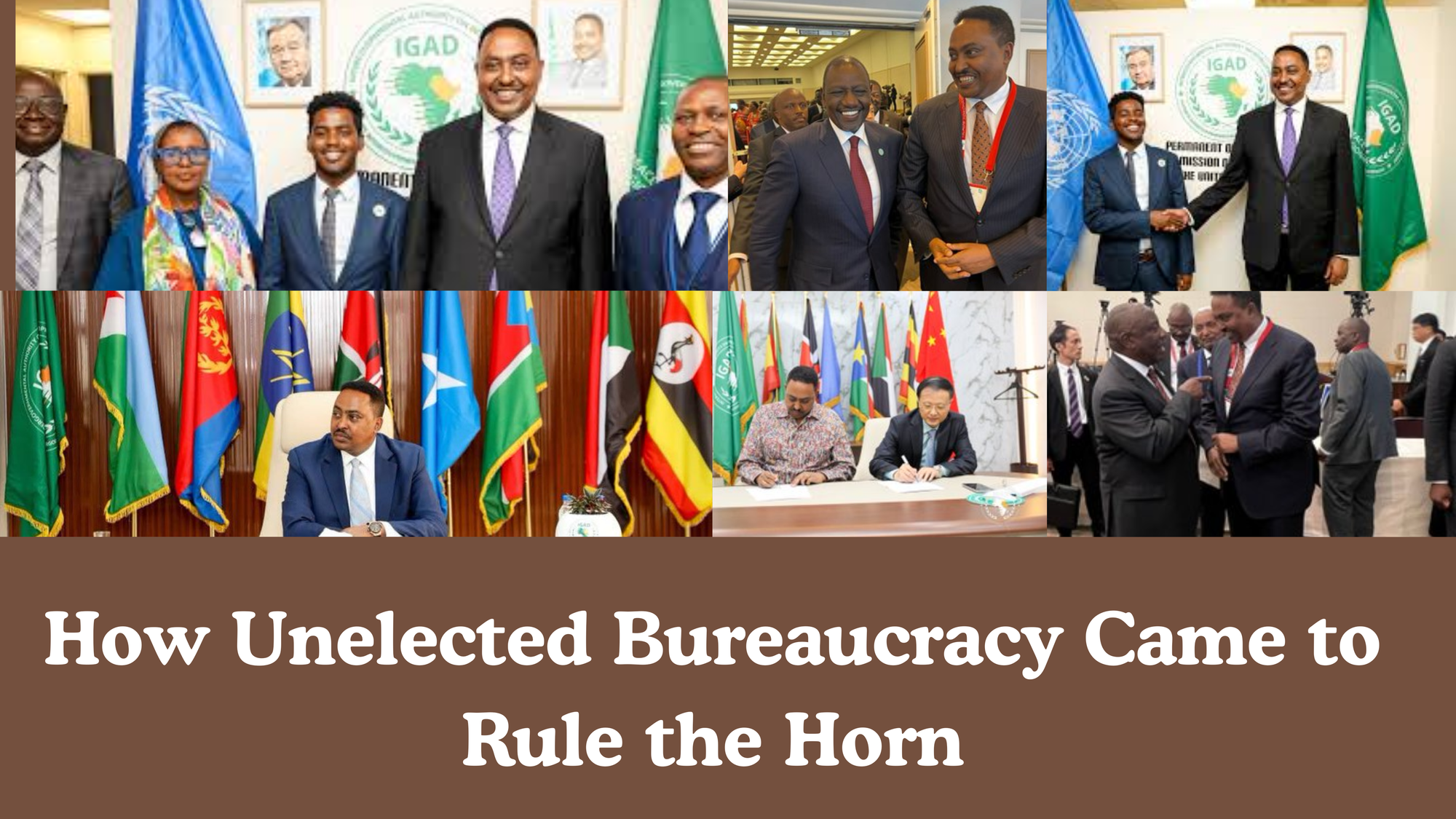
Rather than being bypassed, IGAD has continued to be actively engaged by Western powers—most notably the United States—which have repeatedly used the organization as an intermediary to advance policy objectives while avoiding direct state-to-state accountability. This pattern reveals that IGAD’s persistence is not the result of effectiveness, but of utility: it allows external actors to bypass sovereign governments while projecting decisions as “regional consensus.” Although calls for reform continue to circulate, they remain largely rhetorical, while the organization’s structural flaws—and its role as a proxy instrument—persist unchanged.
Conclusion: An Institution Beyond Reform—and What Comes Next
The Intergovernmental Authority on Development (IGAD) was not merely ineffective. It was instrumentalized. Over time, it became a platform for Ethiopian dominance and a conduit through which global actors imposed agendas under the cover of “African consensus.” With opaque funding streams, insulated leadership, and no meaningful accountability to the people of the region, IGAD ceased to function as a legitimate vehicle for cooperation.
At this stage, IGAD increasingly serves a narrower purpose: bankrolling a permanent secretariat and sustaining the authority of its executive leadership, rather than delivering outcomes for member states. The organization has evolved into a self-preserving bureaucracy—one that prioritizes institutional survival, salaries, conferences, and donor relations over regional stability or tangible results. In this sense, IGAD no longer mediates conflicts or integrates economies; it administers itself.
Institutions designed to manage sovereignty rather than respect it cannot be reformed into instruments of independence.
The failure of IGAD does not leave a vacuum—it clarifies the path forward. The Horn of Africa does not need another externally managed bureaucracy. It needs direct, transparent, bilateral and trilateral relationships between sovereign states, rooted in consent, reciprocity, and clearly defined national interests.
Rather than permanent regional bureaucracies, cooperation should be structured through smaller, functional, issue-based frameworks—formed around concrete objectives such as security coordination, trade corridors, maritime access, or environmental response, and dissolved once those objectives are met. This approach restores accountability, prevents institutional capture, and keeps authority where it belongs: with states and their peoples.
If Africa is serious about self-determination, organizations like IGAD must be exposed for what they have become—and either dismantled or bypassed. Only then does diplomacy return to where it belongs: accountable, sovereign, and real.
NefasitPost relies on the strength of our community. If you value independent Eritrean reporting, timely analysis, and a platform that amplifies our voice, please subscribe and consider contributing. Your support helps us grow, stay independent, and continue telling the stories that matter.
👉 Subscribe or contribute today: https://www.nefasitpost.com/
Comments ()