
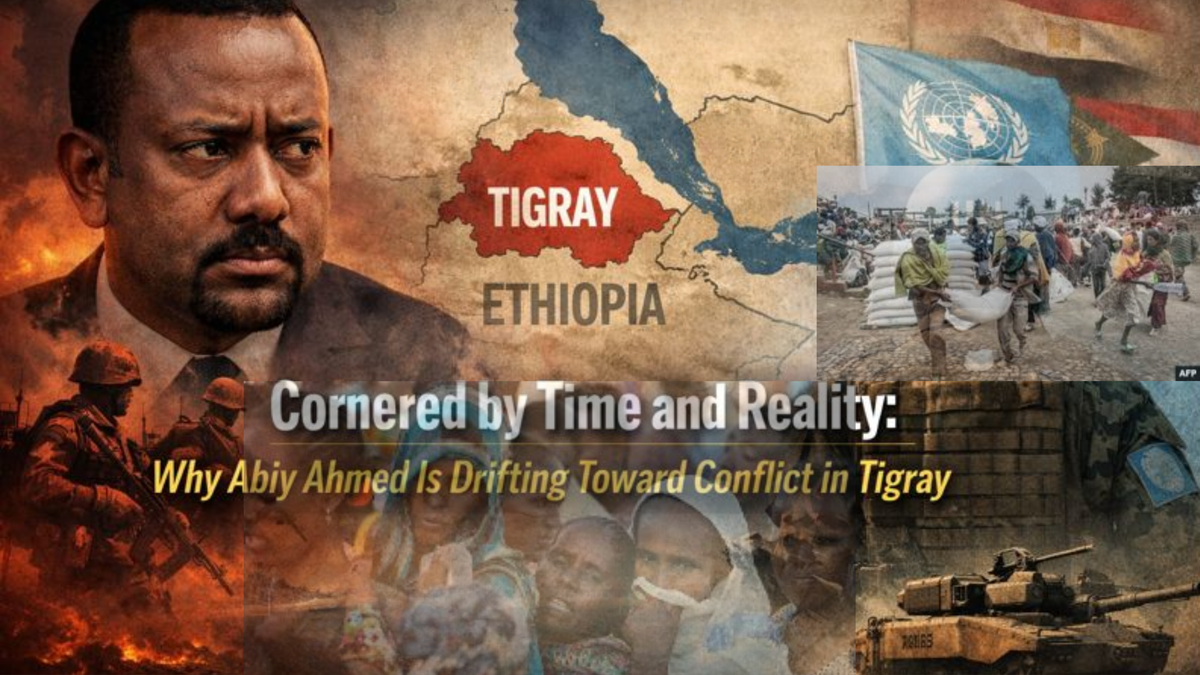
Cornered by Time and Reality: Why Abiy Ahmed Is Drifting Toward Conflict in Tigray
By Amanuel Biedemariam December 17/2025
As elections approach and Ethiopia’s diplomatic, military, and political margins collapse, Abiy Ahmed faces shrinking options. With regional actors aligned against escalation and internal fractures unresolved, the risk of a desperate return to conflict—especially in Tigray—is rising, not receding.
A Strategic Environment That No Longer Permits Escalation
Abiy Ahmed now operates in an environment where bold maneuvers no longer produce strategic advantage. The regional and global conditions that successive Ethiopian governments once benefited from have shifted decisively against him. The Red Sea is now heavily scrutinized and securitized, while regional actors have become intolerant of shocks and unilateral escalation. Washington’s posture has moved from accommodation to a stability-first approach focused on containing risk rather than enabling ambition.
Ethiopia’s diplomatic space and political capital have narrowed sharply amid growing tensions with Sudan, Egypt, and Eritrea—and by extension, actions that undermine Saudi interests. The international system is unwilling to absorb another Horn of Africa war. The United Nations has explicitly reaffirmed the primacy of existing agreements, closing the door on attempts to reopen debates over Red Sea access or rewrite settled arrangements.
“The regional environment that once absorbed Ethiopian escalation now actively resists it.”
Surrounded, Constrained, and Out of Strategic Options
Strategically, Abiy is boxed in. Ethiopia now finds itself effectively surrounded—by Egypt, Sudan, and Somalia—with Egyptian peacekeeping forces deployed in the region. His ability to market war as a legitimate or stabilizing option has evaporated. The United States, the United Nations, the African Union, the European Union, China, Saudi Arabia, Egypt, and key regional actors are united in opposing any new military adventure.
Abiy’s freedom of action is constrained by logistics, legitimacy, and an overwhelming lack of external tolerance for escalation. More critically, Ethiopia no longer possesses the military capacity to sustain a multi-front conflict. Domestically, resistance would be fierce. Significant constituencies in both Amhara and Tigray would oppose renewed war, and any attempt at force would inevitably draw Eritrea into the equation—transforming escalation into an uncontrollable regional confrontation.
“Abiy lacks both the permission and the capability to wage war—and that is precisely what makes this moment dangerous.”
The Internal Fracture: Why Tigray Remains the Pressure Point
At home, the erosion is deeper and more dangerous. Ethiopia is fragmented across multiple internal fronts, with weakening cohesion and loyalty. Tigray sits at the center of Abiy’s dilemma: politically unconsolidated, socially unaligned with his government, and governed by a peace agreement that froze fighting without resolving power, borders, or trust.
The Pretoria Agreement ended open hostilities but left core questions unanswered. Without political control over Tigray, Abiy cannot stabilize the federation, project authority, or shape a credible post-election order. As the election clock accelerates, these unresolved fractures compress his options and push him toward coercive shortcuts rather than political solutions. The people of Tigray are unlikely to permit federal entry or elections conducted through proxy or manufactured local structures.
“Pretoria stopped the war—but it did not end the struggle over authority.”
Why Desperation Points Toward Tigray
- Election pressure: Conflict offers a pretext to delay elections, recast legitimacy, and suppress dissent under the banner of national security.
- Loss of leverage: Ethiopia’s former status as an indispensable aid recipient—buffered by diplomatic cover and regional tolerance—has eroded, making internal coercion appear more attractive.
- An unfinished war: Territorial disputes, unresolved authority, and competing narratives leave Tigray the most combustible fault line in the federation.
The Consequences of Miscalculation
The implications are stark. A renewed conflict in Tigray would not remain localized. It would further fracture Ethiopia, destabilize the state, and send shockwaves across the Horn of Africa, creating serious regional security risks. The human cost—mass displacement, civilian suffering, and institutional collapse—would be immense.
What Abiy Ahmed may calculate as a controlled confrontation is far more likely to become an uncontrollable cascade—one that accelerates Ethiopia’s unraveling rather than postpones it.
“A war meant to buy time may instead exhaust what remains of the state.”
Contact: Aman@nefasit.com
NefasitPost relies on the strength of our community. If you value independent Eritrean reporting, timely analysis, and a platform that amplifies our voice, please subscribe and consider contributing. Your support helps us grow, stay independent, and continue telling the stories that matter.
👉 Subscribe or contribute today: https://www.nefasitpost.com/

Comments ()